
30+ Fundraising examples that actually raise money

Key Takeaways
- Online and crowdfunding examples scale fastest, especially peer-to-peer money pool on Tiing.
- Events build community but cost time, so pair them with an online donation page.
- Recurring giving programs turn one-time donors into stable monthly income.
- Schools win with simple, repeatable examples: discount cards, fun runs, product sales.
- The best fundraising strategy combines two or three examples, not one.
Most people copy the same tired bake sale and wonder why they barely raise money. Generic examples do not match the cause, the audience, or the goal, so they fall flat and burn out the volunteers who ran them.
That is the trap: a $200 afternoon that eats a whole weekend, while the real fundraising goal sits untouched. Donor fatigue sets in, momentum dies, and next year nobody wants to organize anything at all.
This guide fixes that. You get 30+ real fundraising examples sorted by type (online, events, product sales, recurring, corporate, schools), plus a simple way to pick the right one for your situation. Curious how the online side works under the hood? Here is how crowdfunding works.
By the end, you will know which examples fit your cause and how to launch one in minutes with a money pool.
Before the list, here is how to match a fundraising example to your goal, because the format you choose matters more than the effort you put in.
How to choose the right fundraising example for your goal
Picking the right example is half the battle. The wrong one wastes good volunteers on a low-payoff afternoon, while the right one practically funds itself. Run through these four checks before you commit.
- Define the goal first: dollar target, deadline, and what counts as success. Tie every example to a measurable fundraising goal so you know when you have won.
- Know your audience: local community, parents, alumni, or online supporters all change which examples work. A college crowd gives differently than a church group.
- Match effort to payoff: events build buzz but cost time, while online examples scale with low overhead and run around the clock.
- The combo rule: the strongest campaigns stack two or three examples, like a fun run plus an online money pool to capture remote donors who cannot show up in person.
Be realistic about your starting point. A brand-new cause with no email list should lean on personal networks and an online money pool first. An established nonprofit with a donor base can open with a gala. The same example wins or flops depending on the audience already behind you.
And tie everything to a number. “Raise some money for the team” goes nowhere, but “raise $4,000 for new uniforms by March 1” gives donors a finish line to push toward. A concrete goal with a deadline outperforms an open-ended ask every single time.
This table ranks the headline examples so you can hierarchize, not just browse a list and guess.
| Example | Effort | Payoff | Best for |
|---|---|---|---|
| Online money pool (Tiing) | Low | High | Any cause, remote donors |
| Peer-to-peer campaign | Medium | High | Teams and networks |
| Fun run / walkathon | Medium | High | Schools, big crowds |
| Gala or benefit dinner | High | High | Major donors |
| Trivia or game night | Low | Medium | Quick community turnout |
| Bake sale | Low | Low | Fast, casual cash |
The takeaway from this ranking: online examples sit at the top because they cost nothing to start and reach the widest audience. Events and sales rank lower on payoff-per-hour, but they add the community energy and local visibility that pure online drives lack. The smartest play is one from the top of the list paired with one from the middle.
Online and crowdfunding fundraising examples
Online examples reach the people who cannot show up in person, which is most of your potential donors. They cost almost nothing to launch, collect around the clock, and travel anywhere a link can go. For a generation that lives on its phone, this is where the easiest dollars are.

Launch a crowdfunding campaign or money pool
Use Tiing to spin up a shareable money pool in minutes for a cause, project, or emergency. It is the best example for reaching donors far beyond your local circle, and the only setup is a story, a goal, and a link.
This is the workhorse of modern fundraising. A medical bill, a team trip, a disaster relief drive, or a community garden all fit the same simple format, and the visible progress bar does half the persuading for you.
👉 Start a money pool on Tiing today.
Peer-to-peer fundraising
Supporters create their own mini-pages and raise money on your behalf. Each one multiplies your reach through their personal network, turning ten volunteers into ten campaigns. It works especially well for runs, challenges, and anniversary drives where people want to rally their own friends behind your cause.
Social media donation drives
Facebook fundraisers, Instagram donation stickers, and a clear link in bio do the heavy lifting. Pair short video stories with the campaign to boost engagement and shares, and post updates so the algorithm keeps showing your cause to new people. The accounts that win post a face, not a flyer, and reply to every comment to keep the post alive.
Online auction or virtual gala
Run a silent auction online with donated auction items, or host a livestreamed event with a donation page open throughout. Remote bidders push prices higher than a single room ever could, and you keep almost all of it because the overhead is so low.
What actually engages donors online? Three things: a specific ask (“$50 feeds one animal for a month”), social proof through a visible progress bar, and a story about one beneficiary. Our animal sanctuary fundraising example shows this formula in action, breaking a big goal into bite-size, fundable pieces.
Fundraising event examples
Events create stories and bring a community together in one room. They cost more time than online drives, but the energy, photos, and word of mouth they generate keep paying off long after the night ends. Give each one a realistic revenue range so expectations stay grounded.

- Trivia night or game night: low cost, high turnout. Charge an entry fee per team and add a raffle for a second revenue stream. Realistic take: $500 to $2,000.
- Silent or live auction: solicit donated items from local businesses for high margins, since the inventory costs you nothing. Realistic take: $2,000 to $10,000.
- Fun run, walkathon, or charity 5K: pair with peer-to-peer pledges to scale well past the people who actually run. Realistic take: $3,000 and up.
- Gala or benefit dinner: higher effort, ideal for major donors and corporate sponsors who expect a polished evening. Realistic take: $10,000 and up.
- Movie night under the stars: family-friendly and sponsor-friendly with simple ticketing and concessions. Realistic take: $500 to $1,500.
- Themed dinner or cook-off: community-driven and easy to repeat each year. Realistic take: $1,000 to $4,000.
How to plan any of these in one line: lock the date and venue first, recruit volunteers and sponsors second, sell tickets early, and open an online page so people who cannot attend can still chip in. The pre-event ticket push usually decides whether the night clears its goal.
Product and sales-based fundraising examples
Sales examples give donors something tangible in return, which lifts conversion among people who hesitate to “just give.” They also let supporters feel like customers, not charity cases, which widens your pool well beyond the usual donors.
- Bake sale with a twist: themed treats and pre-orders to cut waste and lock in revenue before you bake a thing.
- Merch sales: custom tees, tote bags, and stickers featuring the cause. Supporters become walking billboards.
- Cookie dough, popcorn, or candle drives: classic catalog fundraisers with set margins and built-in supplier support.
- Discount or coupon cards: partner with local restaurants and shops for repeat value that sells itself.
- Car wash or yard sale: near-zero cost and great for quick cash on a single Saturday.
- Restaurant give-back night: a venue donates a percentage of the evening’s sales, and you just bring the crowd.
The trick with product fundraising is margin. A $25 item that costs you $20 nets only $5, so pick products with strong markups or negotiate supplier deals before you launch. Otherwise you sell hard and keep little.
Recurring giving and corporate fundraising examples
These examples build the boring, beautiful thing every nonprofit wants: predictable money that arrives whether or not you are running a campaign that month. One-time drives fund a project, but recurring revenue funds a mission and lets you hire, plan, and grow with confidence.
Monthly giving program
Named donor tiers (for example $10, $25, $50 per month) create stable, predictable income and let you plan a year ahead with confidence. Give each tier a name and a clear benefit so donors know exactly what their gift unlocks.
Membership program
Recurring dues with perks build a committed community around the cause and convert casual supporters into loyal members who renew year after year. Membership turns a one-time gift into a relationship.
Corporate matching gifts
Ask donors to check whether their employer matches gifts. A single check-box can double a contribution for free, yet most donors never think to ask. A one-line reminder in your thank-you email captures money you already earned.
Corporate sponsorships
Offer tiered sponsor packages with logo placement at events and on the campaign page. One mid-size sponsor can underwrite an entire event, so approach businesses in person with a short packet that spells out exactly what they get in return.
Fundraising examples that work for schools
School examples win when they are simple, repeatable, and easy for parents to share. The best ones tie into something families already value, like reading or school spirit, so participation feels natural rather than forced.
- Read-a-thon or math-a-thon: pledge-based and tied directly to learning, so parents feel good about every dollar.
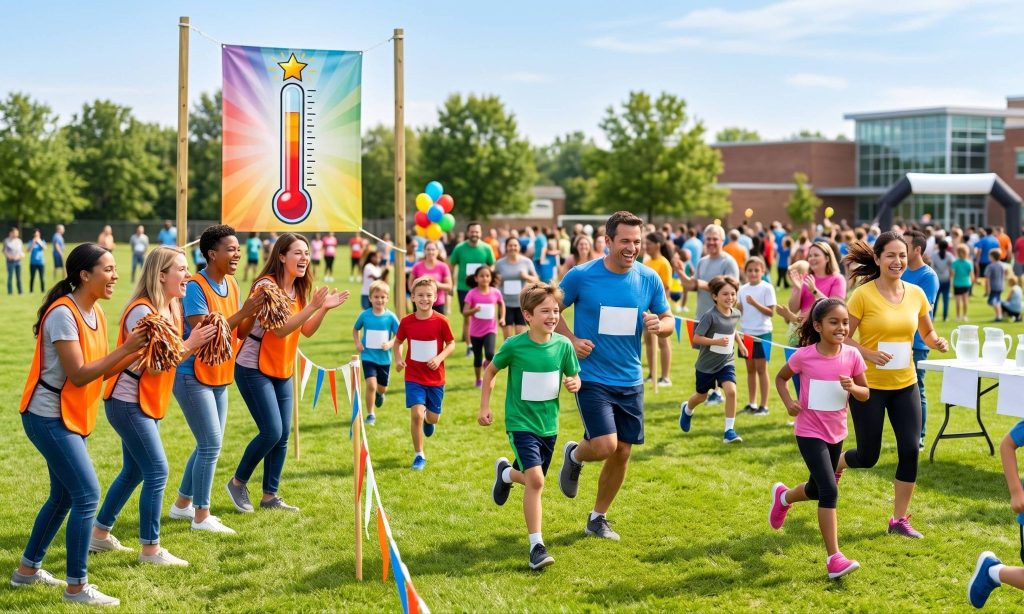
- Fun run or jog-a-thon: the highest-ROI school example, easy to run with peer-to-peer pledges and almost no overhead.
- Book fair or book sale: repeatable and popular with families year after year, with publisher support built in.
- Spirit wear and merch: school-branded apparel sold online to the whole community, from students to alumni.
- Talent show or car wash: engages students directly, builds school spirit, and gives kids a stake in the outcome.
Mini case study: one PTA paired a fall fun run with an online money pool for relatives who could not attend. The run brought in $6,200 from pledges, the money pool added $3,800 from out-of-town grandparents and alumni, and the combined $10,000 beat the $7,500 goal by a third. The lesson: the online layer captured donors the field never reached, and the school broke its record without adding a single new event.
Schools also benefit from repetition. Once a fun run or read-a-thon works, run it the same week every year. Families start to expect it, sponsors plan for it, and each edition takes less effort than the last while raising more.
Why a Tiing money pool powers nearly every fundraising example
Whatever example you run, an online money pool acts as the hub. Every other idea, the gala, the fun run, the bake sale, sends donors back to the same link so nothing slips through the cracks.
- One link, every channel: share by email, text, or social to collect funds beyond the room.
- Captures remote donors: turns any in-person event into a hybrid campaign that reaches out-of-state family and friends.
- Social proof built in: a visible progress bar and contributor messages encourage more giving with every contribution.
- Flexible for any cause: nonprofits, schools, community projects, and personal causes alike, in USD.
There is no setup cost to test the idea. Spin up a money pool, share it with ten people, and you will know within a day whether your story and ask land. That fast feedback is worth more than any amount of upfront planning.
👉 Pick your favorite example, then launch it in minutes. Start a money pool on Tiing today.
FAQ: fundraising examples
The questions organizers ask most before launching, answered so you can move from planning to raising money fast.
What are some unique fundraising examples?
Online auctions, themed events, peer-to-peer campaigns, and challenge campaigns all stand out. A unique angle tied to your specific cause almost always performs better than a generic idea anyone could copy.
How do you raise money for a nonprofit?
Set a clear goal, pick two or three examples, launch an online donation page or money pool, and engage donors with a specific ask and visible social proof. Stacking methods beats relying on one.
What are examples of fundraising events?
Trivia nights, silent auctions, galas, fun runs, movie nights, and bake sales are popular examples. Pair each with an online page to capture donors who cannot attend in person.
What are the easiest fundraising examples to start?
Car washes, yard sales, restaurant give-back nights, and a shareable online money pool are the lowest-effort, fastest examples. They need little setup and deliver quick results.
What fundraising examples work best for schools?
Fun runs, read-a-thons, book fairs, and spirit-wear sales repeat year after year and engage students, parents, and the local community effectively, especially when paired with an online pledge page.
