
25 Real fundraising examples that actually work

Key Takeaways
- Online fundraising (a money pool or crowdfunding) is the fastest way to reach donors across Canada.
- Mix one online method with one event for the strongest results.
- Budget-friendly options (bake sales, car washes) work for small teams and schools.
- Recurring donations build stable, predictable income.
- Pooling funds with a Tiing money pool turns small contributions into one big impact.
Choosing from hundreds of fundraising ideas is paralyzing. You scroll endless lists, bookmark a dozen, and still cannot tell which example actually raises money in the real world.
So volunteers pour effort into low-payoff activities, the clock runs out, and the fundraising goal starts to feel out of reach. Wasted time is the one resource a small team or a busy parent cannot get back, and a stalled campaign quietly drains everyone’s motivation.
Here is the shortcut: 25 concrete, proven fundraising examples, sorted by type (online, events, sales, community), each with its effort level and startup cost. And to fund any of them in minutes, a Tiing money pool. If you want the mechanics first, see how crowdfunding works before you commit to a format.
Let’s start with how to choose the right example for your goal and your audience, because the wrong format wastes good effort.
How to choose the right fundraising example for your goal
The best example is the one that matches your cause, your crowd, and the hours you can spare. Spend five minutes here and you save weeks of misdirected effort.
- Define your fundraising goal and audience first: a nonprofit, a personal cause, a school, or a sports team. The dollar target shapes the format you should pick.
- Match effort vs. payoff: a quick bake sale wraps up in a morning, while a multi-week campaign scales far higher but demands real planning and volunteers.
The pooling hack: instead of chasing e-transfers one by one, share a single Tiing money pool link so everyone contributes in a couple of taps. For charities specifically, our crowdfunding for nonprofits guide digs deeper into receipts and donor management.
One rule separates campaigns that hit their goal from those that stall: never bet on a single format. The strongest results almost always pair one online method, for reach, with one event or sale, for community and local visibility.
Use this quick decision frame to pick before you start planning anything.
Be honest about your starting point too. A brand-new cause with no email list should lean on personal networks and an online money pool first, while an established nonprofit with a donor base can launch a gala on day one. The same example can succeed or flop depending on the audience already in your corner.
| If your goal is… | Time you have | Best example to start with |
|---|---|---|
| Reach donors fast, any cause | A few hours | Online money pool on Tiing |
| Build community + raise funds | A few weeks | Charity gala or dog walk |
| Small team, low budget | One weekend | Bake sale or car wash |
| Stable monthly income | Setup only | Recurring donations |
| Stand out / go viral | Ongoing | Challenge campaign + merch |
If you only remember one thing from this section, make it this: pick the example that fits the time you actually have, not the one that looks most impressive. A modest plan you finish beats an ambitious one you abandon halfway through.
Online fundraising examples (the fastest way to reach donors)
Online formats win on reach and speed. They cost almost nothing to start and travel far beyond your immediate circle, which is exactly where most of your potential donors live.
Launch a crowdfunding campaign or online money pool on Tiing: tell your story, set a goal, and share the link by email or social media. It is the single most flexible example on this list, working for a medical bill, a school trip, or a community project alike.
- Run a peer-to-peer campaign: supporters create their own sub-pages and raise money on your behalf, multiplying reach through their networks. Ten supporters become ten campaigns, each tapping a circle you could never reach alone.
- Set up recurring or monthly donations: predictable income that lets a nonprofit plan ahead instead of lurching from one drive to the next. Even modest monthly gifts add up to a dependable budget.
- Use a registered-charity portal like CanadaHelps for tax-receipted donations, which reassures donors who want a receipt at tax time.
- Host a virtual event: a live-streamed tour, an online auction, or a webinar opens your cause to supporters anywhere in the country.
The reason online examples outperform is simple: zero friction. No cash to count, no cheques to deposit, and a progress bar that quietly nudges every visitor toward giving. They also work around the clock, collecting while you sleep and reaching donors in other cities or provinces who would never make it to an event.
Fundraising event examples (in-person ideas that build community)
Events turn supporters into a crowd. They cost more time but generate buzz, photos, and momentum that money cannot buy. They also give local media and sponsors something to rally around.
- Charity gala or dinner with a silent auction of donated prizes. High effort, high return, ideal for an established community of major donors. Realistic take: $5,000 and up.
- Walkathon, run, or dog walk with pledges per kilometre. Animal causes thrive here; see how shelters do it in our animal sanctuary fundraising guide. Realistic take: $2,000 to $8,000.
- Sports tournament (hockey, golf, ball) with entry fees and local sponsors. Friendly competition drives sign-ups. Realistic take: $1,500 to $6,000.
- Trivia night or bingo at a local venue or Legion hall. Low cost, reliable turnout, easy to repeat monthly. Realistic take: $500 to $2,000.
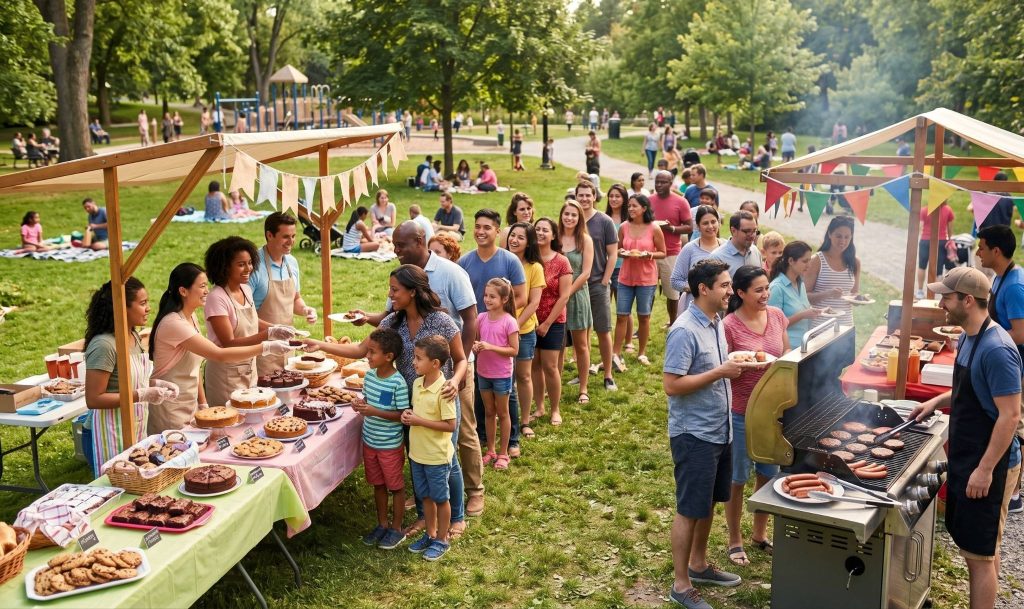
- Community BBQ or corn roast with ticketed entry and a 50/50 draw on the side. Realistic take: $800 to $3,000.
One tactic doubles most event totals: run an online money pool alongside the event. People who cannot attend still give, and your reach stretches well past the room. Treat every in-person event as a hybrid one and the math changes in your favour.
One tactic doubles most event totals: run an online money pool alongside the event. People who cannot attend still give, and your reach stretches well past the room.
Budget-friendly and easy fundraising examples (low cost, high turnout)
Small startup cost, big neighbourhood energy. These examples suit schools and volunteer teams perfectly because they need almost no upfront cash and lean on people, not budgets.
- Bake sale or a Tim Hortons-style coffee morning outside a busy shop or rink.
- Car wash run by a school or sports team on a Saturday, with pre-sold tickets to guarantee turnout.
- Bottle or can drive that turns returns into refunds for the cause, perfect after a community event.
- 50/50 raffle at a game or event, where the pot grows with every ticket sold.
- Used book or clothing sale that clears closets and funds the goal at the same time.
- Recurring monthly giving: name your donor tiers (Guardian at $25, Hero at $50) so supporters know exactly what their gift unlocks. It is the quiet engine behind stable income.
What separates a $200 bake sale from a $1,200 one is usually promotion, not the baking. Announce it a week ahead, pre-sell where you can, and post the goal so passersby know what they are supporting. The same effort with better promotion routinely earns several times more.

Creative and unique fundraising examples (stand out from the crowd)
When the usual ideas feel tired, originality is what gets shared. These examples ride attention and travel on social media, where a fresh angle beats a familiar ask every time.
- Custom merchandise or T-shirt campaign featuring your cause. Supporters become walking ads and you raise funds twice over.
- Sponsor-a-___ program (a tree, a pet, a classroom item) that creates a personal, lasting connection.
- Viral challenge campaign (a step challenge, a polar dip) shared across social media with friends tagging friends.
- Pet photo contest or talent show with public voting by donation, which turns spectators into givers.
- Themed dinner, cooking class, or mystery box that bundles a real experience with the act of giving.
Why do these work? Each one taps a psychological trigger. A challenge campaign uses social proof as friends tag friends. A sponsor-a-pet program leans on reciprocity through updates and photos. A 48-hour push creates urgency with a visible deadline. Match the trigger to the cause and the example outperforms a generic ask, often by a wide margin.
A quick example of stacking done right: a Toronto hockey team paired a Saturday car wash with an online money pool for relatives out of province. The car wash brought in $900 in an afternoon, the money pool added $1,600 from grandparents and former teammates, and the combined $2,500 covered the tournament fees with room to spare. Neither example alone would have reached the goal, but together they did.
Comparison table: fundraising examples at a glance
Here is how the most popular examples stack up on effort, cost, and fit. Scan it once and you will know which two to pair, and which to skip for now.
| Example | Type | Effort | Startup cost | Best for |
|---|---|---|---|---|
| Tiing money pool | Online | Low | $0 | Any cause, fast reach |
| Peer-to-peer campaign | Online | Medium | $0 | Teams, networks |
| Recurring donations | Online | Low | $0 | Nonprofits |
| Charity gala | Event | High | $$ | Major donors |
| Dog walk / walkathon | Event | Medium | $ | Community causes |
| Trivia night | Event | Low | $ | Quick turnout |
| Bake sale | Sales | Low | $ | Schools, small teams |
| Merch / T-shirt drive | Sales | Medium | $ | Awareness + funds |
| 50/50 raffle | Sales | Low | $ | Events |
| GoFundMe campaign | Online | Medium | Fees apply | General crowdfunding |
| Kickstarter project | Online | High | Fees apply | Product launches |
Notice the pattern: online examples sit at the top because they cost nothing to start and reach the widest audience. The familiar platforms still work, but they often come with fees, which is why pairing a low-cost online money pool with one community event tends to net the most for the cause.
How to promote your fundraising campaign
A great example still needs eyes on it. Promotion is where good causes get funded, and where most volunteers leave money on the table by going quiet too soon.
- Share the link everywhere: email, social media, and group chats. Make giving one tap away, every time you post.
- Tell a story with photos and a clear goal. People give to people and to one vivid beneficiary, not to abstract numbers.
- Post updates and thank donors publicly to keep momentum rolling and signal that the campaign is alive.
- Recruit ambassadors to reshare with their own networks and double your reach for free.
A small habit pays off here: explicitly ask people to share. Most supporters are happy to help but never think to forward the link. A simple line like “share this with three friends” can widen your reach overnight. And keep the cadence steady: a campaign that posts an update every few days raises far more than one that goes silent after launch day.
Why a Tiing money pool is the easiest way to bring any example to life
Whichever example you choose, an online money pool acts as the backbone. It centralizes contributions and lends instant credibility to your effort.
- Easy collecting: no chasing e-transfers, just one shareable link for the whole campaign.
- Pool small contributions into one big result that no single donor could have funded alone.
- Mobile-first: contributors give in a couple of taps from their phone, wherever they are.
- Works for CAD and USD, any cause or event, with a progress bar that builds social proof as it climbs.
Think of the money pool as the hub and every other example as a spoke. The bake sale, the gala, the walkathon all send donors back to the same link, so nothing slips through the cracks and you can see the total climb in real time.
👉 Pick an example above, then set it in motion. Start your Tiing money pool today.
FAQ: fundraising examples
The questions Canadian fundraisers ask most often, answered directly so you can move from reading to doing.
What are fun fundraising ideas?
Fun examples include a pet photo contest, a trivia night, a viral challenge campaign, a themed dinner, and a talent show where the public votes by donation. They mix entertainment with an easy reason to give.
How do you raise money for a nonprofit?
Combine an online money pool or crowdfunding campaign with one event, set a clear goal, use tax-receipted tools like CanadaHelps, and promote consistently on social media. Stacking two methods reliably beats relying on a single one.
What are budget-friendly fundraising ideas?
Bake sales, car washes, bottle drives, 50/50 raffles, and used book sales all carry a low startup cost and high community turnout. They suit schools and small volunteer teams that need quick, dependable results.
How do you organize a fundraising event?
Pick a format, set a date and a goal, line up volunteers and sponsors, sell tickets, promote early, and collect funds through one online link so people who cannot attend can still give.
How do you promote a fundraising campaign?
Share the link by email, social media, and group chats, tell a story with photos, post regular updates, thank donors publicly, and recruit ambassadors to reshare with their own networks.
