
45 charity fundraising ideas that raise real money in Canada

Key takeaways
- Pair two or three proven charity fundraising ideas with one online collection point instead of six scattered campaigns.
- Easy fundraising ideas like a 50/50 draw, a bake sale or a loonie and toonie drive launch this week with almost no budget.
- Peer to peer fundraising and a focused crowdfunding campaign raise the most per volunteer hour for small Canadian charities.
- Events still matter: a walk-a-thon, a silent auction or a trivia night builds relationships that online giving alone cannot.
- A Tiing money pool takes five minutes to set up, collects in CAD, and needs no account from your donors.
Your charity needs money and your volunteers are already stretched thin. The board wants a bigger program budget, the wait list keeps growing, and the same four people run every event. Nobody on your board signed up to become a fundraiser, and everyone is doing this after work.
So you fall back on what you did last year. The bake sale clears $180 after costs. Half the pledges arrive as e-transfers nobody can match to a name, and two cheques sit in a drawer until March. Someone is still owed $40 for cups. By the time the treasurer reconciles it all, the momentum is gone and nobody wants to fundraise again.
There is a better pattern. Pick two or three ideas that genuinely fit your cause, then run every dollar through one online collection point so each gift lands in the same place with a name attached. Small charities that do this raise more with fewer volunteer hours, and they finish the year with a donor list, not a shoebox of receipts.
Below are 45 charity fundraising ideas that work in Canada, sorted by effort and by type, with what each one realistically brings in. For a broader list beyond the charitable sector, our roundup of fundraising ideas in Canada covers teams and schools too.
How to choose the right charity fundraising idea
Most fundraising efforts fail for the same reason: the idea was chosen because it sounded fun, not because it matched the cause, the crowd or the calendar. Three quick decisions fix that, and the rest of the plan writes itself.
Match the idea to your cause and your donor base
The best charity fundraiser is the one your supporters were already willing to say yes to. A hospice foundation and a youth arts nonprofit can both run an auction, but the items look nothing alike.
- Look at who gave last year: pull your last 50 donations and note the average gift and how people paid. Retired volunteers respond to a mailed appeal, not a livestream.
- Match the ask to the mission: a food bank runs a great community dinner, an animal rescue runs a great dog walk. The closer the activity sits to your work, the easier the story is to tell.
- Count your real volunteer hours: a gala needs a committee of ten, a 50/50 draw needs two.
- Decide if you need a receipt: a registered charity can issue CRA donation receipts for eligible gifts, and that changes which ideas are worth the paperwork.
Weigh effort, cost and expected profit
Some ideas raise $200 for forty hours of work, others raise $5,000 for four. Use the table below as a rough guide, then pick one low-effort idea and one bigger idea.
| Idea | Effort | Average profit (CAD) | Best for |
| Online money pool | Low | $500 to $5,000 | Any cause, fastest to start |
| 50/50 draw | Low | $200 to $2,000 | Community groups, sports clubs |
| Bake sale or car wash | Low | $150 to $700 | Schools, small volunteer teams |
| Peer to peer campaign | Medium | $2,000 to $15,000 | Registered charities |
| Walk-a-thon or fun run | Medium | $1,000 to $10,000 | Health and community causes |
| Silent auction | High | $2,000 to $20,000 | Charities with business partners |
| Charity gala | High | $10,000 to $75,000 | Organizations with a donor list |
| Golf tournament | High | $5,000 to $50,000 | Causes with corporate networks |
These are orders of magnitude, not promises. A first-year walk-a-thon with 30 walkers lands at the bottom of its range, the same event in year four at the top.
Set a goal, a deadline and one place to collect the money
A campaign without a number is a wish. Pick a figure tied to something concrete, because “help us reach $12,000 to keep the after-school program running until June” raises far more than “support our charity”. Deadlines turn intention into a donation.
Then pick one place for the money to land, and one only. Cash boxes, personal e-transfers and a cheque address all at once is how small charities lose track of $600. One online fundraising page gives you a single running total, a name against every contribution, and a link you can drop into an email or a group chat.
Easy charity fundraising ideas you can launch this week
The best charity fundraising ideas combine low setup effort with a high return: an online money pool, a peer to peer campaign, a silent auction, a walk-a-thon and a 50/50 draw. Start with one online option to collect funds in one place, then add one event to bring the community together.
- Online money pool: one shareable link, live in five minutes.
- Peer to peer campaign: your supporters raise money on your behalf.
- 50/50 draw: half the pot to the winner, half to the cause.
- Bake sale or car wash: near-zero cost, great for youth volunteers.
- Silent auction: donated prizes, high margin, no inventory risk.
Launch an online money pool and share one link
An online money pool is the fastest way to raise money for charity when you need funds moving this week. You create the pool, set a target, and share one link by text, email or social media. Donors pay by card in two clicks with no account to open.
It suits a $500 emergency appeal or a $20,000 capital push, and it doubles as the collection layer under every other idea here: ticket money, pledges and auction payments all land in the same pool.
Bake sale, car wash and yard sale
These three are the workhorses of Canadian community fundraising: no budget, no expertise, and something real for younger volunteers to do.
- • Bake sale: volunteers donate baked goods and you sell them at a school or community centre. Expect $150 to $600, and price in round dollars so nobody needs change.
- • Car wash: a team washes cars in a donated lot for a suggested donation rather than a fixed price. A busy Saturday brings in $400 to $900.
- • Neighbourhood yard sale: families donate items and you run one multi-family sale for the cause. A good sale clears $300 to $1,200.
- • Book sale: collect used books for a month, sort them into three price tiers and sell them over a weekend. A reliable $200 to $800.
Loonie and toonie drive, 50/50 draw and raffle
Coin and chance fundraisers are a Canadian staple, and they work because the ask is tiny. Nobody says no to a toonie.
- Loonie and toonie drive: place labelled jars at partner businesses and ask for a single coin at the till. A four-litre jug holds more than you think, and ten locations over a month raise $500 to $2,000.
- 50/50 draw: sell tickets during an event, split the pot with the winner and keep the rest. A natural add-on to any game or dinner, typically $200 to $2,000.
- Prize raffle: local businesses donate the prizes, you sell tickets for weeks and draw at a final event. Margins are excellent, but a provincial gaming licence is required and every province sets its own rules.
- Loonie and toonie auction: guests buy coins and drop them in bags beside small donated items, then you draw one coin per bag. Playful, and it clears a lot of donated goods.
Round-up at checkout with a local business
Partner with a local shop or café and ask them to invite customers to round their bill up to the nearest dollar. It costs the business nothing and puts your cause in front of hundreds of people.
The pitch matters more than the mechanics. Bring a one-page sheet with your registration number, a photo of the program the money funds, and a clear end date. A month-long round-up at a busy café or a Canadian Tire franchise commonly returns $400 to $2,500.
Birthday and milestone fundraisers for your cause
Ask supporters to give up a gift and ask for donations instead. A birthday, an anniversary, a retirement or a memorial tribute all work the same way: the person creates a page for your charity and shares it with friends and family.
These are small individually and large in aggregate. One birthday fundraiser might raise $300 to $800, but twenty across a year is a program budget, and each introduces your organization to a fresh circle of people.

Online and virtual charity fundraising ideas
Online fundraising is where small charities get the most leverage, because a good link travels further than any poster. It also removes the two things that drain volunteers: venue logistics and cash handling.
Peer to peer fundraising campaigns
Peer to peer fundraising turns your supporters into fundraisers. Each participant gets their own page, sets a personal target and asks their own network to donate. You provide the cause and the materials. They provide the reach.
This is the highest-return online format for most small charities, because you borrow dozens of contact lists instead of leaning on your own. Recruit ten committed people, give each a $500 goal, and a two-week push lands between $3,000 and $8,000. Team pages beat individual ones, since a friendly competition keeps everyone posting.
Crowdfunding campaign for one specific project
Where peer to peer spreads the ask, a crowdfunding campaign concentrates it on one tangible thing: an accessible van, a commercial fridge for the food bank, the roof on the community centre. Specific beats general, because donors can picture what their $50 buys.
Write the page around the object, not the organization. Show the price, break it into parts people can fund, and post a photo the day it arrives. These campaigns commonly raise $2,000 to $25,000.
Virtual auctions, online trivia nights and livestreams
Virtual fundraising events cost almost nothing to stage and reach supporters who moved away years ago but still care.
- Online silent auction: post donated items with photos and let people bid over a week. No room to rent, no catering, and bidding often beats an in-person auction on small items.
- Virtual trivia night: run rounds over video, charge a $10 to $20 entry fee per household and sell hint packs during play. A 40-household game brings in $500 to $1,200.
- Gaming or craft livestream: a supporter streams for six or twelve hours with your donation link pinned on screen. Popular with youth volunteers, and worth $300 to $3,000.

Social media fundraisers and how to promote them
Social media does not raise money on its own. It raises money when it points somewhere. Every post and story should end at the same link, and that link should open a page where giving takes under a minute.
- Post the number, not the plea: “$3,200 of $8,000, seven days left” outperforms “please donate”, because progress is contagious.
- Show one person, one outcome: a single photo of the family your program helped beats a graphic with three statistics.
- Ride a giving day: Giving Tuesday Canada in early December is the one date when your audience already expects a charitable ask.
Donation forms, QR codes and recurring giving
Every gap between the ask and the payment costs you donations. A donation form with three suggested amounts, a QR code on your printed materials and a monthly giving option are the three fixes that pay for themselves fastest.
Print the QR code on posters, tickets and volunteer shirts. Ask for monthly gifts at the end of every campaign, since a $20 monthly donor is worth $240 a year. And say on the form whether a CRA donation receipt will be issued, because that sentence removes the most common reason people hesitate.
Tiing versus the other platforms used by Canadian charities
Not every platform is built for a small Canadian organization working in CAD with volunteer staff. Some are made for registered charities with a finance team, others for personal causes.
| Platform | Setup | CAD support | Best for | Donor account needed |
| Tiing | 5 minutes, no paperwork | Native CAD, built in Montreal | Any cause collecting money fast with one link | No, card payment in two clicks |
| FundRazr | Moderate, form and review | CAD | Peer to peer campaigns for nonprofits | No, optional sign-up |
| Zeffy | Moderate, charity verification | CAD | Registered charities wanting a full toolkit | No, optional sign-up |
| CanadaHelps | Moderate, charity verification | CAD | Registered charities issuing CRA receipts | Optional, for receipts |
| GoFundMe | Moderate, identity checks | CAD | Personal causes seeking wide reach | No, optional sign-up |
The practical read: if you are a registered charity that needs automated tax receipts on every gift, a dedicated charity platform earns its place. If you need money moving this week, Tiing gets you there in five minutes with one link and no account required from your donors. Schools and parent committees start here, and our list of school fundraising ideas shows how that plays out.
Charity fundraising events that draw a crowd
Events are slower and more expensive than online campaigns, and you should still run one. An evening together turns a name on a list into a person who cares, and gives local businesses a reason to sponsor you. Pick one anchor event a year.
Walk-a-thon, fun run and dog walk
Pledge-based events scale with participation instead of budget. Walkers collect pledges, you collect entry fees, and the route costs nothing.
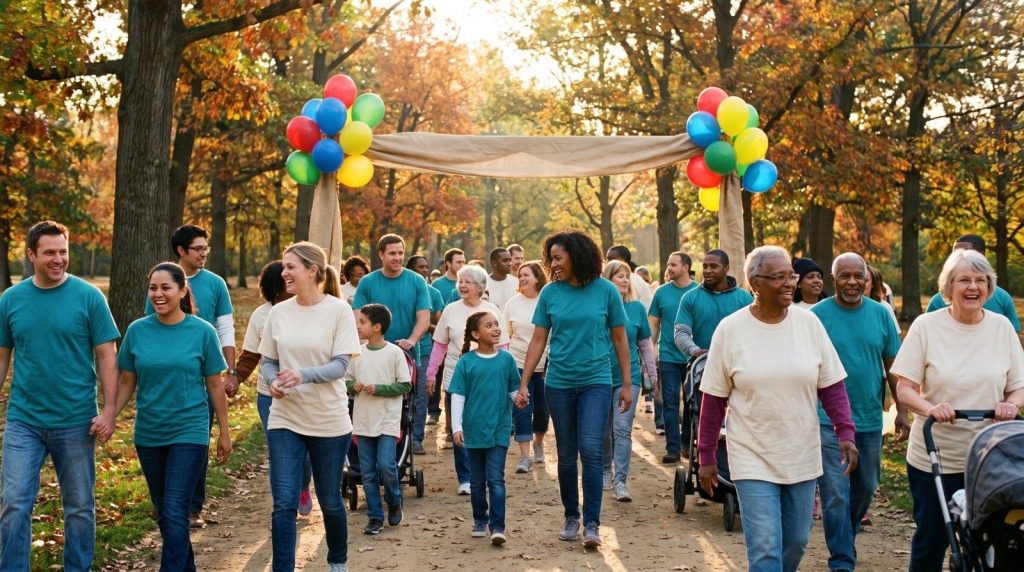
- Walk-a-thon: participants gather pledges for a set distance and walk it on one morning. Forty participants in year one raises $1,000 to $4,000, and later years with team captains clear $10,000.
- Fun run or colour run: charge a $25 to $40 registration fee, add sponsor banners along the route and hand out medals. Popular with families and easy to photograph.
- Dog walk: ideal for animal charities, with a small entry fee per dog, donated treats and a best-costume prize. It brings out people who have never attended a charity event.
Silent auction and charity gala
Auctions and galas raise the most money per guest of anything here, and they demand the most preparation. Start soliciting donated items three months out.
- Silent auction: display donated items with bid sheets during a reception and close bidding at a set time. With zero cost of goods, a room of 100 guests produces $2,000 to $20,000.
- Charity gala or dinner: sell tickets or tables, add a live auction, and build the evening around one client story told well. Budget carefully so the food does not eat the profit.
Golf tournament and community sports tournaments
Sports tournaments monetize three ways at once: entry fees, sponsorships and on-site extras. That layering makes them profitable.
- Charity golf tournament: sell foursomes at $500 to $1,200 and hole sponsorships at $250 to $500, then add a 50/50 draw. The classic corporate fundraiser.
- Ball hockey or three-on-three tournament: charge a team registration fee, run it in a community rink and sell refreshments. Cheaper than golf and more accessible for a minor hockey community.
Trivia night, movie night and concerts with local artists
Low-cost social events are the most repeatable part of a fundraising calendar, and people come back.
- Trivia night: teams of six pay $60 to $90 per table, and you sell mulligans, hint cards and a 50/50 during the game. Fifteen teams clears $1,200 to $2,500.
- Movie night: screen a family film in a school gym or park with popcorn and refreshments by donation. A low-pressure entry point for new supporters.
- Concert with local artists: musicians donate a set, you sell tickets and run a merchandise table. Artists get exposure, you reach an audience that would never attend a gala.
Seasonal and holiday events
Tie your event to a date people already have in their head and half the promotion is done for you.
- Polar plunge or winter challenge: participants collect pledges for jumping into a very cold lake in January. High energy, highly shareable and unmistakably Canadian.
- Spring plant sale: pre-sell seedlings and hanging baskets from a local grower in April and distribute them on one Saturday. Predictable margins, very little waste.
Your event checklist: permits, donated prizes, volunteers, promotion, payment
The difference between an event that nets $4,000 and one that nets $600 is rarely the idea. It is the six weeks before it. Work backwards from the date and give every line an owner.
| Task | Owner | When |
| Confirm venue, insurance and any municipal permit | Event lead | 8 weeks out |
| Apply for a provincial gaming licence for a raffle or 50/50 | Treasurer | 8 weeks out |
| Solicit donated prizes and sponsorships from local businesses | Two volunteers | 6 weeks out |
| Open the online pool and publish the ticket link | Treasurer | 5 weeks out |
| Recruit volunteers for setup, door and cleanup | Volunteer lead | 3 weeks out |
| Promote on social media and partner mailing lists | Communications | 3 weeks out |
| Confirm on-site payment and print QR codes | Treasurer | 1 week out |
| Send thank-you messages and the final total | Event lead | 3 days after |
Unique charity fundraising ideas that stand out
If your community has seen the same bake sale for eleven years, novelty is worth real money. Unique fundraising ideas earn attention, and attention is what convinces someone to give to a cause they had not thought about that morning.
Challenge fundraisers: silence, fasting, head shave, polar plunge
Challenge fundraisers work because the sacrifice is visible, and visible sacrifice makes the ask impossible to ignore. Participants collect pledges for doing something genuinely hard.
- Sponsored silence: a participant stays silent for 24 hours and posts updates with a whiteboard. Cheap, funny and effective with students.
- 24-hour fast: a group fasts together for a food security cause, with hourly updates and a shared meal at the end.
- Head shave: a supporter shaves their head once a pledge threshold is met. One head shave regularly raises $1,000 to $5,000 and generates more photos than anything else here.
- Polar plunge or endurance challenge: cold water, long distances or 24 hours of something repetitive. Set a milestone that unlocks the stunt so donors feel they caused it.
Skill and talent auctions
Instead of auctioning objects, auction what your supporters can do. A lawyer offers an hour of advice, a chef cooks dinner for six, a photographer shoots a family session.
Talent auctions suit charities with a professional or artistic supporter base, and the margins are perfect because every lot costs you nothing. Twenty donated services in a week-long online auction brings in $1,500 to $6,000.
Scavenger hunts and city-wide games
A scavenger hunt turns your town into the venue. Teams pay an entry fee, receive a list of photo challenges tied to local landmarks and partner businesses, and submit their photos through a group chat within a set period of time.
Costs are near zero and the promotion is automatic, since every team posts their photos while they play. Charge $80 to $120 per team of four and a 20-team hunt nets $1,500 to $3,000.
Art shows, book sales and craft markets with local artists
Selling creative work raises money and builds relationships with a part of your community that often wants to help but is never asked.
- Charity art show: local artists donate pieces or a share of sales, you host an evening with music, and buyers leave with something they love. Expect $1,000 to $8,000.
- Large-scale book sale: collect donated books for two months, then run a two-day sale with a bag sale on the final afternoon.
- Craft and maker market: charge vendors a table fee, raffle donated items in the middle of the floor and sell refreshments at the door.
Awareness campaigns tied to a giving day
Some campaigns raise awareness first and money second, which is right when your cause needs explaining before it needs funding. Tie yours to a date the public already recognizes.
Giving Tuesday Canada is the obvious anchor. Build two weeks around one message, ask five supporters to share their own story, and pair it with a matching gift from a board member or a local company. Matching offers lift totals sharply, because “your $50 becomes $100 until Friday” is the most persuasive sentence in fundraising.
The most popular fundraising activities in Canada
Some formats keep appearing on Canadian charity calendars for one reason: they work, year after year, in towns of every size. The table shows what each returns and how much lead time it needs.
What Canadian donors give to most
Canadian giving concentrates around causes with an obvious local face and an obvious local outcome. Food security, hospital foundations, animal welfare, youth sport and disaster relief draw the widest support. December, driven by Giving Tuesday Canada and the tax year deadline, is the busiest giving month by a wide margin.
| Activity | Typical net (CAD) | Lead time | Best fit |
| Online money pool | $500 to $5,000 | Same day | Any charity or community group |
| 50/50 draw | $200 to $2,000 | 2 weeks plus licence | Sports clubs, community events |
| Walk-a-thon | $1,000 to $10,000 | 8 weeks | Health and community causes |
| Silent auction | $2,000 to $20,000 | 10 weeks | Charities with business partners |
| Trivia night | $800 to $2,500 | 4 weeks | Small nonprofits, young donors |
| Product sale | $400 to $3,000 | 6 weeks | Schools, teams, youth groups |
Ideas that work best for small charities and community groups
With two or three active volunteers, choose ideas with a short setup and no inventory. A monthly giving push, a peer to peer campaign built around five committed supporters and one community dinner a year will out-earn a crowded calendar of small events.
Corporate support belongs here too. Ask local employers about matching gift programs, offer tiered sponsorship at your anchor event, and approach a Tim Hortons franchise or a favourite neighbourhood restaurant about a give-back night. These asks take one meeting.
Ideas that work best for schools, teams and youth groups
Young volunteers are your greatest asset and your biggest constraint: enormous energy, very little time.
- Read-a-thon: students collect pledges per book read, which ties the fundraiser to something the school already wants.
- Product sale: chocolate, cookie dough or coffee through a supplier built for Canadian groups, with a two-week selling window.
- Class or team money pool: one link per group so parents chip in from their phone instead of sending 30 separate e-transfers.
Ideas that work best in the workplace
Workplace campaigns are quick, contained and often matched by the employer, the best value per hour in this section.
- Casual Friday: staff pay $5 to dress down, and a 200-person office raises $1,000 a month with no organizing.
- Office bake-off or chili cook-off: colleagues compete, everyone pays to taste and vote, and the winner picks the next charity.
- Payroll giving and matching: small automatic deductions doubled by the employer, the most reliable recurring revenue a charity can hold.
- Team challenge entry: a company enters a team in your walk, pays the entry fee sponsorships and fundraises internally on your behalf.

How to keep participants and donors motivated
Most campaigns do not fail at launch. They fail in week two, when the first burst of enthusiasm fades and nobody has heard a number since. Motivation is a system, and four habits keep participants fundraising.
Set visible milestones and share progress updates
Break the goal into stages people can see. A thermometer at $2,000, $5,000 and $8,000 gives you three reasons to post, and each milestone is news rather than another plea. Tie each stage to a real outcome: $2,000 is a month of meals.
Update twice a week during an active campaign. Silence reads as failure, and donors who think a campaign has stalled stop sharing it.
Use friendly competition, leaderboards and small prizes
A leaderboard between teams, classes or departments does more for participation than any reminder email. Keep the stakes light: a trophy that circulates, a pizza lunch, the right to soak the principal.
Recognition works better than value. Naming the top three fundraisers in your newsletter costs nothing and pushes people to make one more ask. Prizes donated by local businesses close the loop: the business gets a mention and you keep every dollar raised.
Thank donors fast and show the impact of every dollar
Thank people within 48 hours, always. A short personal message beats a polished template sent three weeks later, and a phone call to anyone who gave over $250 is the highest-return hour in fundraising.
Then close the loop with proof. Send one photo and two sentences showing what the money did, even to people who gave $20. If you are a registered charity, issue the charitable donation receipt promptly rather than in a February batch.
Make giving take less than a minute
Count the taps between your post and a completed donation. Anything over four is costing you money. The page should load fast on a phone, offer three suggested amounts and accept a card without an account.
Remove the friction upstream too. One link everywhere, a QR code on everything printed, no login and no forms asking for a mailing address you will never use.
How to raise money for charity online with Tiing
Tiing is a money pool and crowdfunding platform built in Montreal, designed for the situation most small Canadian charities are in: money needed soon, no technical staff, and donors who should not have to create an account to help. It is rated 4.8 out of 5 by the people who use it.
Set up in five minutes and collect in CAD
Create your page, name the cause, set a target and add a photo. That is the whole setup, and it takes about five minutes with no paperwork. Everything runs in native CAD, so donors see Canadian dollars and you never explain an exchange rate.
Payments are processed securely through Stripe and transfer to your bank account. Cards, Apple Pay and Google Pay are all accepted, which matters when half your donors are giving from a phone at a hockey rink.
One link instead of chasing e-transfers
You share one link. It works in a text message, a Facebook post, a QR code on a poster or a group chat with 40 parents. Donors tap it, pay in two clicks and leave a message with their name attached.
That single change removes the worst part of volunteer fundraising: no more matching anonymous e-transfers to pledge sheets, no more cheques waiting to be deposited. Your treasurer sees one running total in real time.
What it costs and what your charity keeps
Contributions land in one place and transfer to your bank account, so the money stays visible from the first donation to the final payout. Current pricing is published on the Tiing fees page, and there is nothing to pay before you start.
The real benefit is time. Volunteers who are not reconciling payments are volunteers who are recruiting participants, calling businesses for donated prizes and thanking donors, which is where the money actually comes from.

Create your charity money pool and start raising money today
FAQ: charity fundraising ideas in Canada
What are the most unique charity fundraising ideas?
Challenge fundraisers stand out most: sponsored silence, a 24-hour fast, a head shave or a polar plunge. Skill auctions, city-wide scavenger hunts and charity art shows with local artists also draw attention because donors have rarely seen them before.
How do you raise money for charity quickly?
Open an online money pool, set a specific target with a deadline, and share one link with your supporters by text and social media. Add a matching gift from a board member so early donations count double and the total climbs fast.
What are the easiest fundraising options for a small charity?
A 50/50 draw, a bake sale, a loonie and toonie drive at partner businesses and a birthday fundraiser all need almost no budget. Pair one of them with an online collection page so every dollar lands in the same place.
What fundraising events can a small charity organize?
Walk-a-thons, trivia nights, silent auctions, community dinners, movie nights and ball hockey tournaments all suit small volunteer teams. Start with one anchor event a year, secure donated prizes from local businesses, and sell tickets online rather than handling cash.
How do you encourage participants to keep fundraising?
Give them a personal target, a leaderboard and a deadline. Share progress updates twice a week, celebrate milestones publicly, and provide ready-made text and photos so asking their friends and family takes under a minute.
How do you use social media to raise money for charity?
Post progress numbers rather than pleas, show one person and one outcome, and send your supporters a paragraph they can copy and share. Point every post at the same link, and time your biggest push around Giving Tuesday Canada.
Do you need a permit for a charity fundraising event in Canada?
It depends on the activity and the province. Raffles and 50/50 draws require a provincial gaming licence, and food sales, alcohol service or street closures usually need municipal approval. Check with your municipality and provincial regulator early.
Can a charity issue a donation receipt for money raised online?
A registered charity can issue CRA donation receipts for eligible gifts collected online, provided the donor received no material benefit and the charity holds the required donor details. Ticket sales and auction purchases follow different rules, so confirm eligibility first.
